

Hangman's Arc
Albert Pierrepoint's turnabout

I had read somewhere in passing that at one point in Albert Pierrepoint’s career as Britain’s chief hangman he had executed twenty-seven people in less than twenty-four hours. His obituary in The New York Times also mentioned it, as did newspapers across the country that ran the syndicated story, but I haven’t been able to corroborate this statistic anywhere else.
Pierrepoint was born in Clayton, West Riding of Yorkshire, England on March 30, 1905. His father, Henry, and his uncle, Thomas, Henry’s older brother, were executioners before him. From 1901 to 1905, Henry worked predominantly as an assistant to two other official executioners who were also brothers, William and John Billington, whose father, James, was an executioner as well. James suffered from emphysema and died ten days after his last execution on December 13, 1901. William and John also had an older executioner brother named Thomas, who died in 1902 at age 29 or 30 of pneumonia. William, who at 27, was a minor celebrity in England, being a young hangman from 1902 to 1904. He worked his last execution in December 1904. Willaim had an alcohol problem and was arrested in the summer of 1905 for not making an obligatory payment to his wife as part of a separation order, causing him to spend a month in prison. In August 1905, while William was in prison, his brother John fell through the open trapdoor while setting up a scaffold for the hanging of Thomas Tattersall and cracked his ribs. He died a couple of months later as a result of those injuries by way of either pleurisy or nephritis (reports and the death certificate contradict each other).
Thus, Henry Pierrepoint became principal executioner. The Billington dynasty gave way to the Pierrepoint dynasty as Henry convinced his brother Thomas to become an executioner the following year. Thomas was onboarded in a stable using rope and sacks of corn and added to the official executioner list in 1906. In 1912, Thomas executed Frederick Seddon, who poisoned his lodger, Eliza Barrow, with arsenic, the crime of which became an inspiration for theatrical, radio, and television works, including “The Waxwork,” a 1959 episode of Alfred Hitchcock Presents.
When Henry’s son, Albert, was nine years old, he introduced him to a friend as a future executioner. The seed was planted and Albert believed he was chosen by a higher power and put on this planet for the job.
In 1910, after nine years and 105 executions (though The Guardian reported 99 with six of them being double hangings, including his assisting the executions of Amelia Sach and Annie Walters, a.k.a “the Finchley baby farmers”), Home Secretary Winston Churchill removed Henry’s name from the official executioner list.
Henry had arrived drunk at Chelmsford prison the afternoon before he was set to hang Frederick Foreman. The prison officer’s report said that after a few minutes in the gate lodge Pierrepoint’s drunken behavior culminated with his hitting fellow executioner John Ellis with his fist. Churchill then confirmed the Prison Commission’s decision to eliminate him from the list, noting on the file, “Make certain this fellow is never employed again.”
A confidential notice circulated among sheriffs instructing them Henry’s name had been removed from the official list of executioners. Henry was never told, however, writing to Churchill the following year begging for his job back, believing Ellis had been trying to get him sacked. He went on to work odd jobs here and there and published his memoirs in the newspaper in 1916. Young Albert hadn’t known the extent of his father’s other career until he read about it in the paper, informing him of his family history and furthering his own resolve. Henry died on December 14, 1922, at age 45. His brother, Thomas, and John Ellis continued as principal executioners.
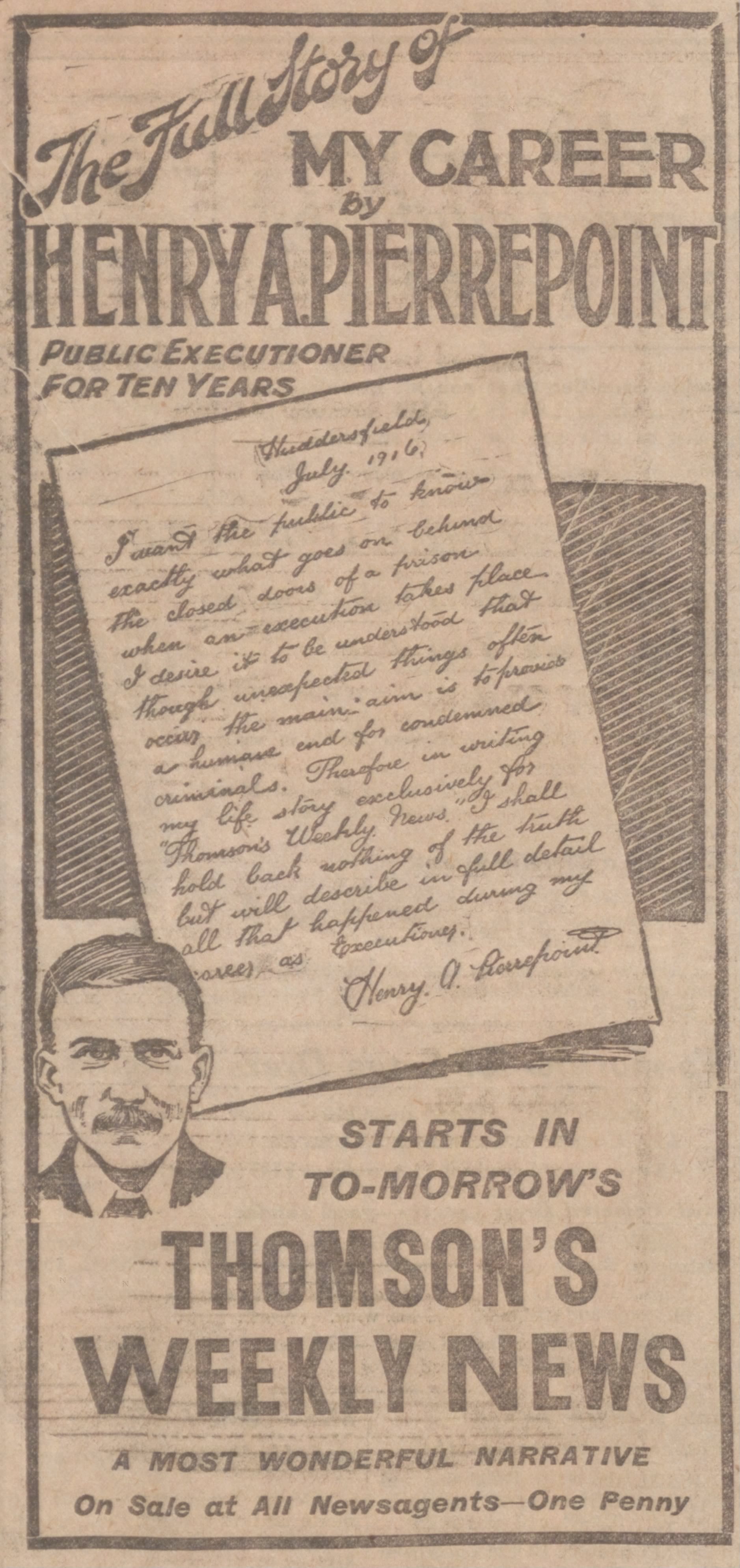
Albert inherited his father’s notebooks containing his memoirs and a diary that included a list of details about each execution. Another decade would go by as Albert worked jobs in a mill and a grocery store, but ever determined, he wrote to the Prison Commission in 1931 asking to be an assistant executioner. Though he was initially denied due to no vacancies, he was invited for an interview six months later. He was accepted, trained for four days at a London prison, and received his acceptance letter to be an assistant executioner in September 1932.
Three months later, his uncle, Thomas, was contracted by the Irish Free State for an execution in Dublin and, since it was outside of Britain, he could choose his own assistant. So, he brought Albert with him.
For the next several years, Albert worked both in the grocery store and as an assistant executioner. Most of his execution work was with Thomas, making Albert like a nepo baby of British executioners, not unlike the Billington boys before him.
That being said, Albert put a lot of thought into his work and hangman calculations. In fact, in July 1940 Albert was the assistant at the execution of Indian revolutionary Udham Singh, who had been convicted of assassinating the colonial administrator Sir Michael O'Dwyer. The day before the execution, Stanley Cross, the newly promoted lead executioner who had trained in 1932 around the same time as Albert, became unclear with his calculations of the drop length. Albert then stepped up, advised on the correct measurements, and was soon added to the list of head executioners.
Uncle Thomas, however, seemed to be following in his brother’s reckless footsteps. The Prison Commission received letters complaining that he smelled strongly of alcohol during two executions at Durham Prison in 1940. In February 1943, a letter from the medical officer at Liverpool Prison described how Thomas by working too quickly had put his assistant at risk. The assistant’s role was to ensure the legs of the condemned were securely tied. A governor of the jail said Thomas “appeared to me to allow only the barest margin of safety in assuring himself that the assistant was clear of the trapdoors before pulling the lever.”
Despite reservations, the authorities were forced to continue employing Thomas because they couldn’t anyone to replace him at the peak of World War II. Albert once recalled Thomas telling him: “If you can’t do it without whisky, don’t do it at all.”
Albert moved up the executioner list and Thomas maintained his standing until 1946 after the war had ended. He died at his daughter’s home in 1954 at age 83.
Albert’s first execution as lead executioner was the hanging of Antonio “Babe” Mancini in October 1941. He was given the height and weight of Mancini, viewed him through the “Judas hole” in the door to estimate his build, then went to the execution room adjacent to the prisoner’s cell and tested the equipment using a sack of the same weight as the prisoner. He calculated the length of the drop using the Home Office Table of Drops (created after failed hangings, configuring rope length based on body weight and drop force). Albert left the sack hanging on the rope to ensure the rope was stretched, allowing for readjustment, if necessary.
The length of time from entering Mancini’s cell to opening the scaffold’s trapdoor took twelve seconds. The neck was broken in almost exactly the same position in each hanging, known as “the hangman's fracture.” Albert would continue to the employ the “Long Drop” method throughout his career, calculating and refining to ensure minimal suffering and a quick unconsciousness.
During the war he hanged German spies, U.S. servicemen who committed capital crimes in England, and in December 1945, following the freeing of the Bergen-Belsen concentration camp (the camp where Anne Frank was sent) and the trial of the camp's officials, Albert was sent to Hamelin, Germany to execute eleven of those sentenced to death, plus two other German war criminals convicted of killing an RAF pilot in the Netherlands. In 1946, Albert became the chief executioner.
Between December 1948 and October 1949 he made several trips to Hamelin, which was the central execution site for the British occupation zone, executing 226 people, dozens of Nazis, frequently over ten people a day, and sometimes groups of up to seventeen over two days, according to Leonora Klein’s A Very English Hangman: The Life and Times of Albert Pierrepoint (2006)—though not twenty-seven over a twenty-four hour period as mentioned in his obituary. One of the executed was William Joyce, an American who carried a British passport, who broadcast propaganda from Germany by way of his radio character “Lord Haw Haw.”
In 1955, Albert executed Ruth Ellis, who was convicted of murdering race car driver David Blakely with whom she was in an abusive relationship. It was a high-profile case. A petition of 50,000 signatures was sent to the Home Secretary, Gwilym Lloyd George, to ask for a delay, but he refused. Ellis was the last woman to be hanged in Britain.
Two weeks later, Albert carried out his last execution. He resigned on February 23, 1956. There were rumors in the press it had something to do with an alleged incident during Ruth Ellis’ execution, but he denied that anything unusual had happened. Later, it was revealed his resignation may have been over a payment dispute. Executioners were not salaried but paid per execution, so they almost all had other jobs. Albert had gone to Manchester for another execution and paid staff to fill in at the bar he was running. The day prior to the scheduled execution, he made his calculations for the drop and set up the rope. However, that evening the prisoner was given a reprieve. Due to poor weather, Albert stayed overnight in a hotel before heading home. Two weeks later, he received money for his travel expenses, but not his execution fee, which Albert claimed he had been paid before in cases of reprieve. After back and forth with the Prison Commissioners and the instructing sheriff, Albert requested that his name be taken from the list of executioners. He was succeeded by Harry Allen, one of Britain’s last executioners, who had assisted him on several executions.
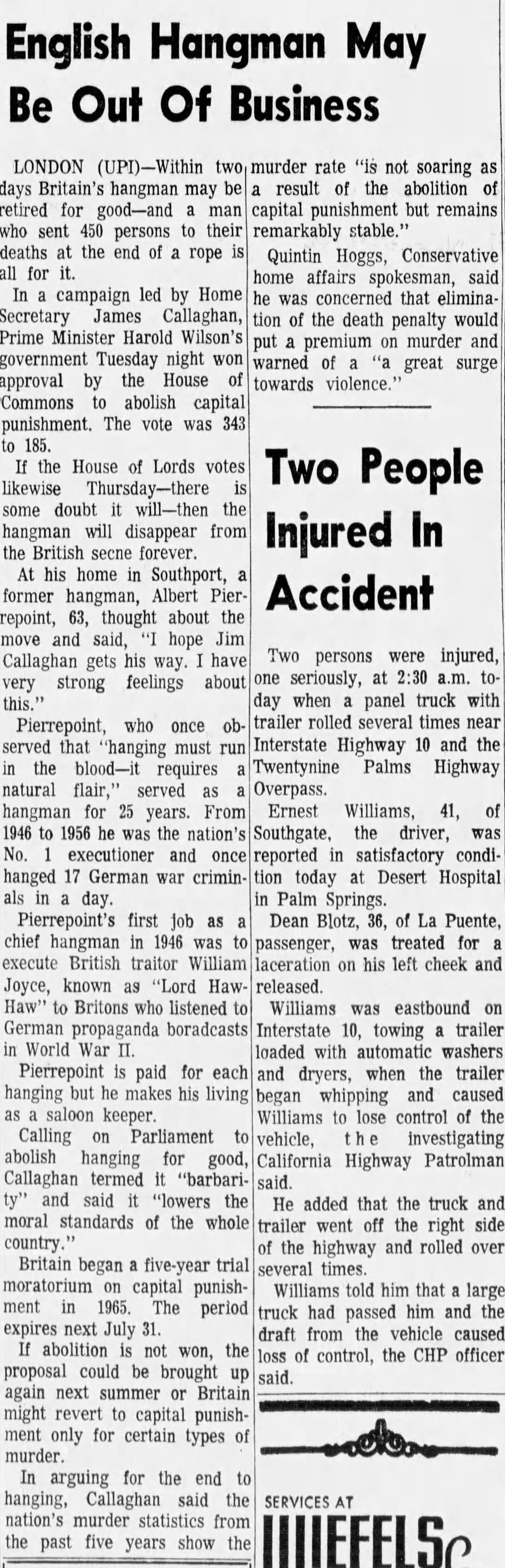
In 1969, British Home Secretary (and later Prime Minister) James Callaghan spearheaded a campaign to abolish the death penalty, and it succeeded. After it was passed in the House of Commons and the day it up in the House of Lords, Albert was quoted in the paper as saying, “I hope Jim Callaghan gets his way. I have very strong feelings about this.”
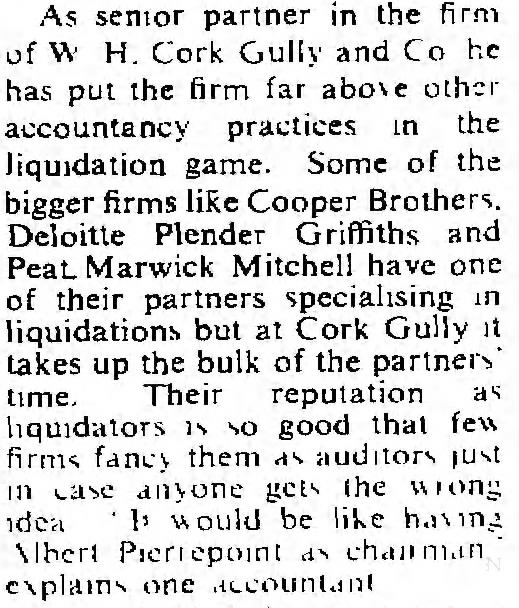
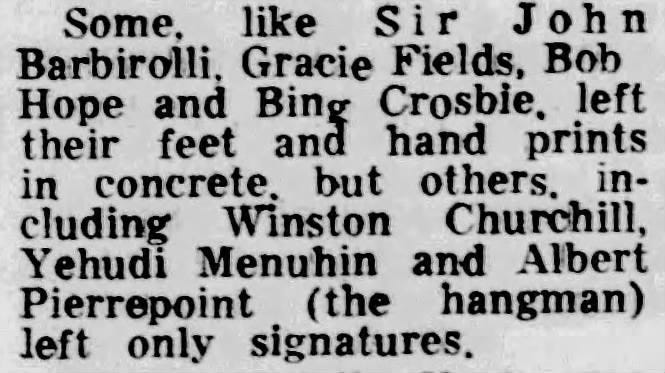
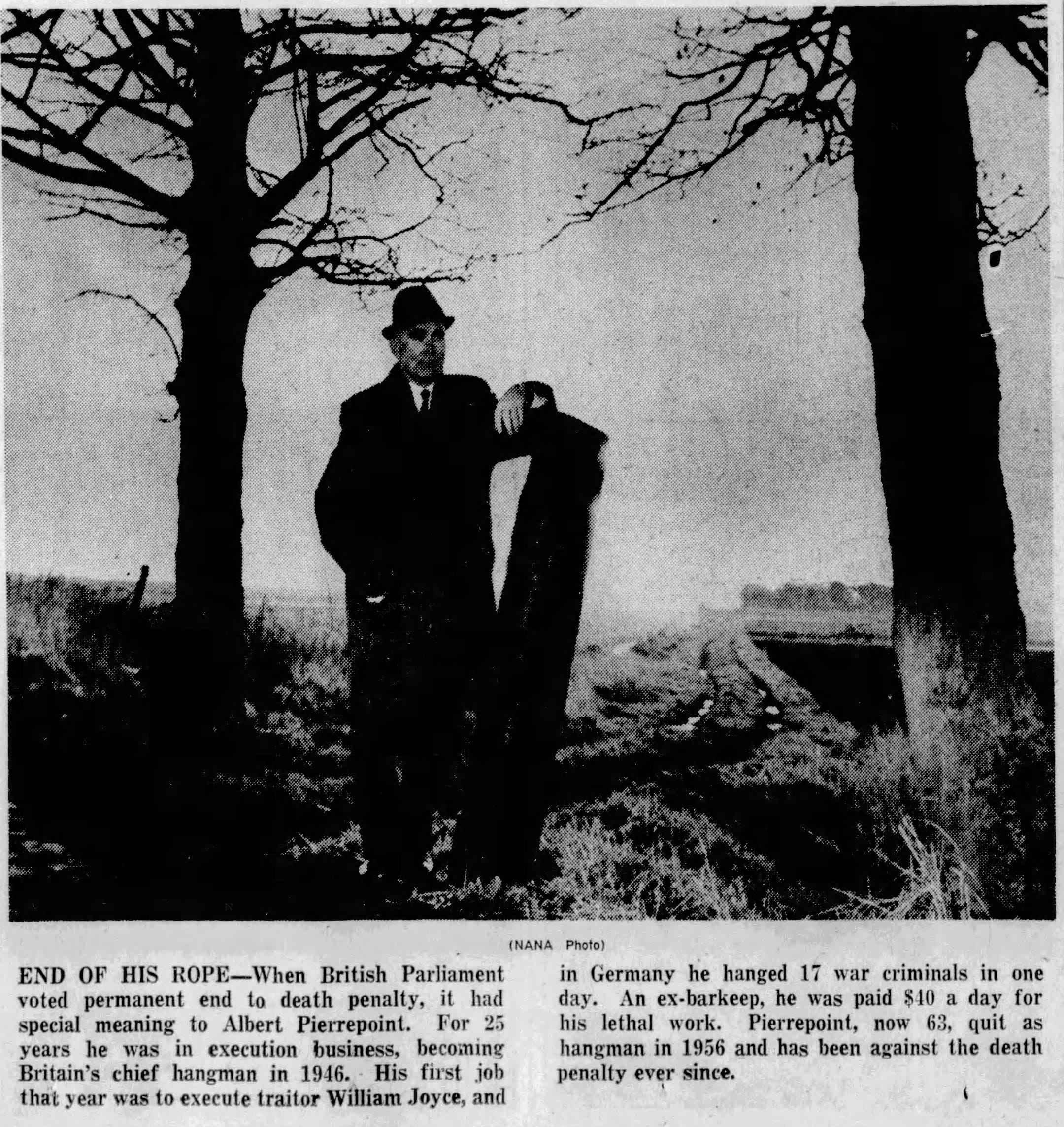
Albert Pierrepoint, Britain’s most prolific executioner credited with somewhere between 450 to 600 executions had since changed his view on the death penalty. The job had become part of his identity for so long and he was often stopped by the public who expressed their appreciation for ending the lives of Nazis. Albert had become a minor celebrity, a household name in the United Kingdom, which is evident in the papers when he’s referenced in an analogy or reportedly signing his name in a new stadium’s concrete along with other notables.
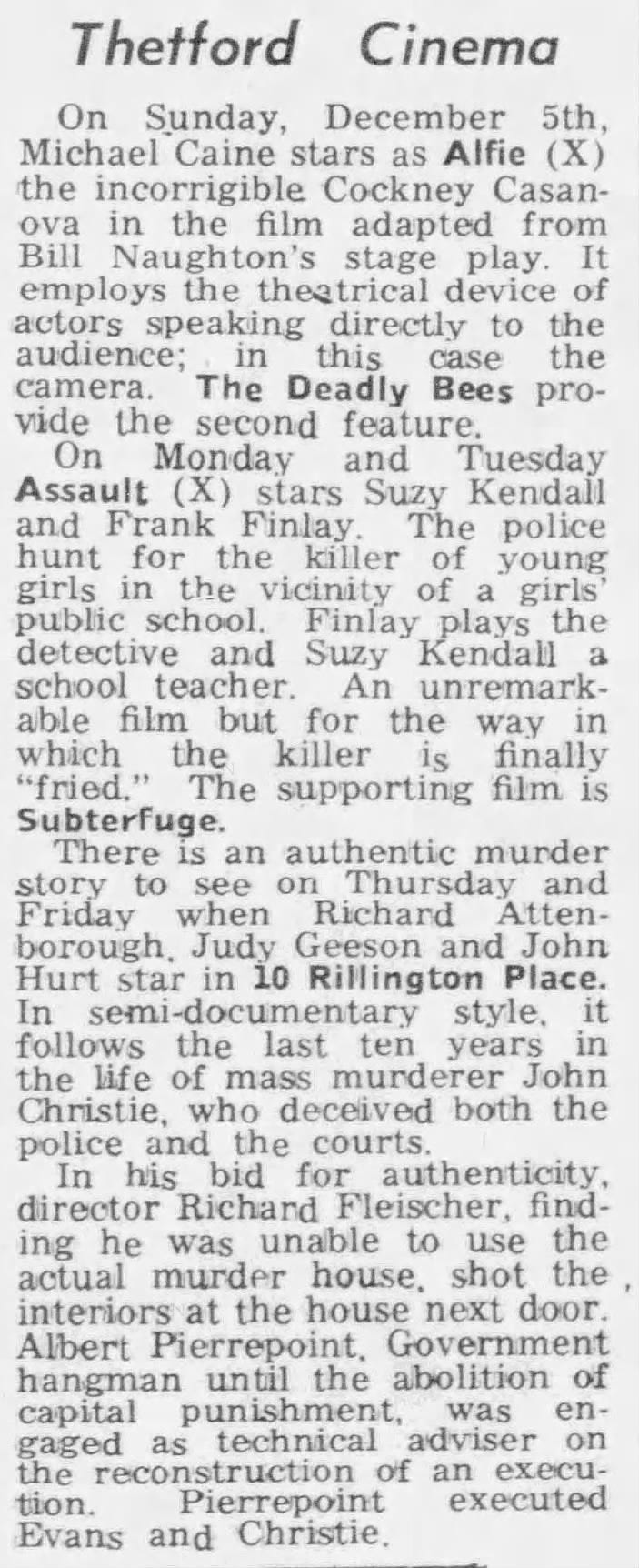
Albert was even employed as a technical consultant for a few showbiz productions, such as Richard Fleischer’s 10 Rillington Place (1971) where advised on the reconstruction of an execution of one of his past jobs.
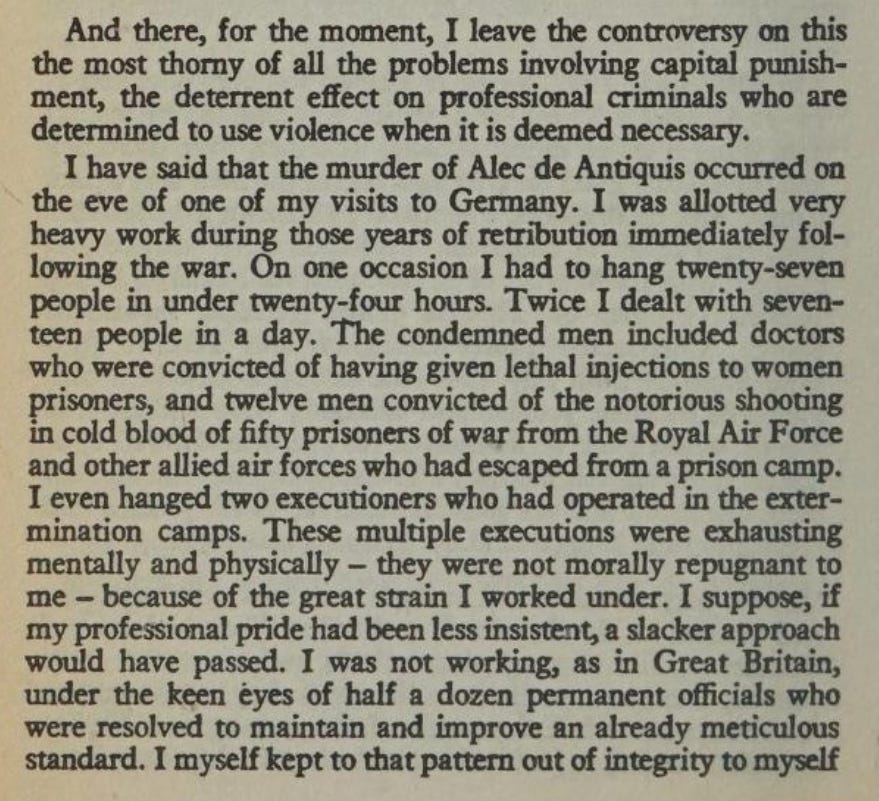
In 1974, Albert published his memoir, Executioner, Pierrepoint, where he writes about his feelings about capital punishment in the book’s introduction:
“It is a fact which is no source of pride to me at all - it is simple history - that I have carried out the execution of more judicial sentences of death (outside the field of politics) than any executioner in any British record or archive. That fact is the measure of my experience. The fruit of my experience has this bitter after-taste: that I do not now believe that any one of the hundreds of executions I carried out has in any way acted as a deterrent against future murder. Capital punishment, in my view, achieved nothing except revenge.”
Ah! His memoir! It was in his own words in those pages where reporters found he had once executed twenty-seven people in a twenty-four-hour period. It may be possible, I suppose, but the online British Executions database, if comprehensive, lists only twenty-five executions each in 1945 and 1952, tied as the most in a single year during Albert’s career. Telle est la mort.
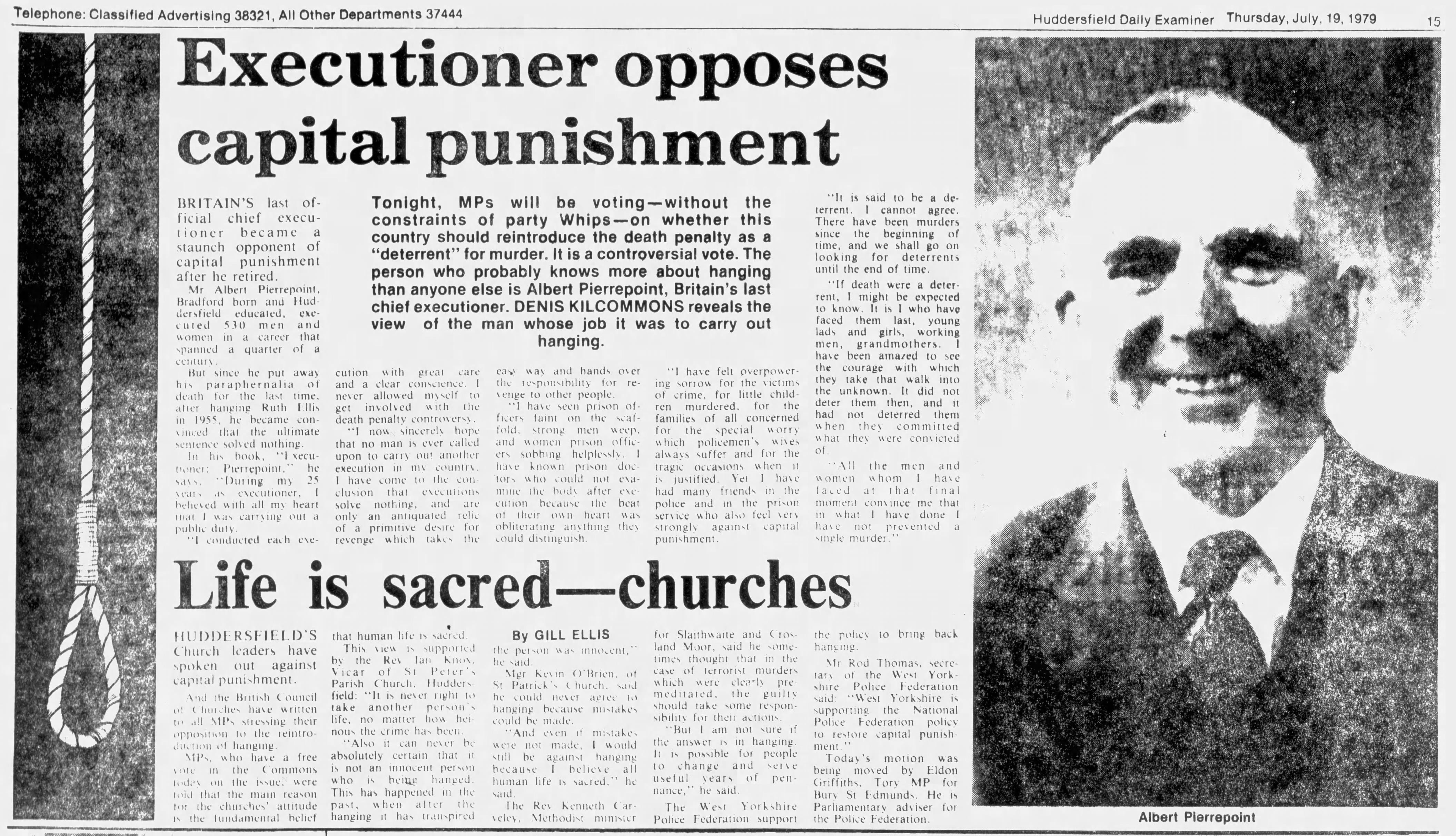
A few years later, on July 19, 1979, when a motion was introduced by Conservative Member of Parliament Eldon Griffiths to reintroduce capital punishment—after a decade of rising violent crime in England—Albert’s opposition was once again brought up in the papers almost a quarter of a century since he resigned. The motion was defeated in the House of Commons by 362 votes to 243 votes.
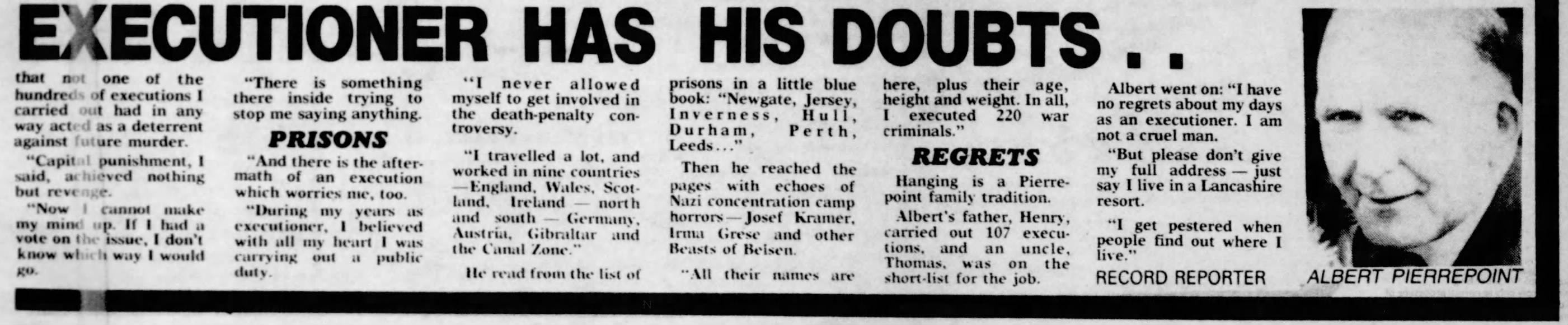
Yet, on July 13, 1983, Glasgow, Scotland’s Daily Record ran an article full of quotes from Albert where he walked back his adamant anti-capital punishment stance to a place of indecision, presumably due to rising violent crime in Great Britain in the 1970s and early 1980s, saying, “Now I cannot make my mind up. If I had a vote on the issue, I don’t know which way I would go.”
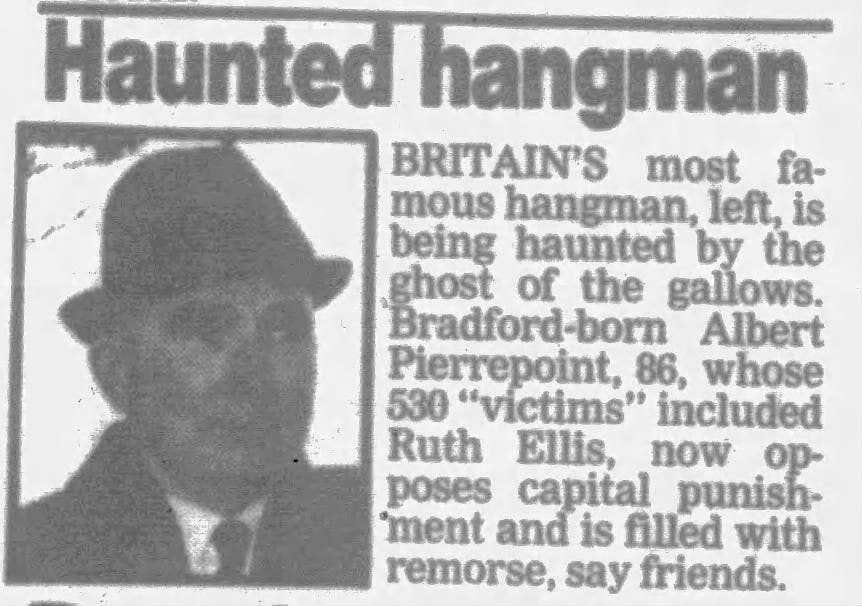
On May 13, 1991, however, a gossip blurb ran in Bradford, West Yorkshire’s Telegraph and Argus reporting that Albert was “being haunted by the ghost of the gallows” and “filled with remorse,” according to information from his friends, suggesting he was confronting his conscience in his final months.
The ghosts were catching up to him.
Albert died the following year on July 10, 1992. Harry Allen, who had succeeded Albert as Chief Executioner (and who wore a bowtie at each execution as a sign of respect for the condemned), died five weeks later. The era of the British executioner had ended.
Albert was survived by his wife, Anne, to whom he had dedicated his memoir, which reads:
“To ANNE my wife
who in forty years never asked a question
I dedicate this book with grateful thanks
for her loyalty and discretion”
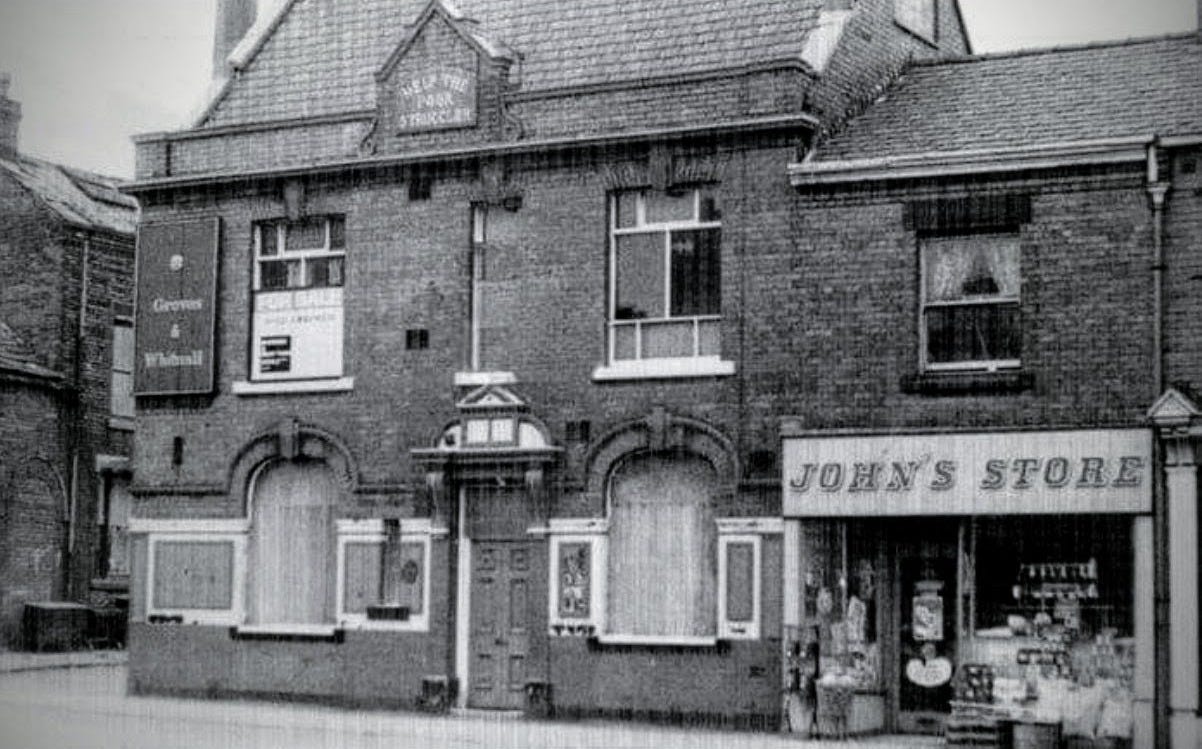
After the war, Albert and Anne ran a pub (a patron of which Albert later met again on the scaffold) in the Hollinwood area of Oldham in Greater Manchester called…
Help the Poor Struggler.
Excellent piece. Really nice to find your ‘Stack.
This was a great one. Have you ever seen the Spanish film by Berlanga, The Executioner? If not, I think you'd really love it. Pretty sure it's on criterion.